


Beyond the Office: How Artists Are Bringing RISO Print to Life
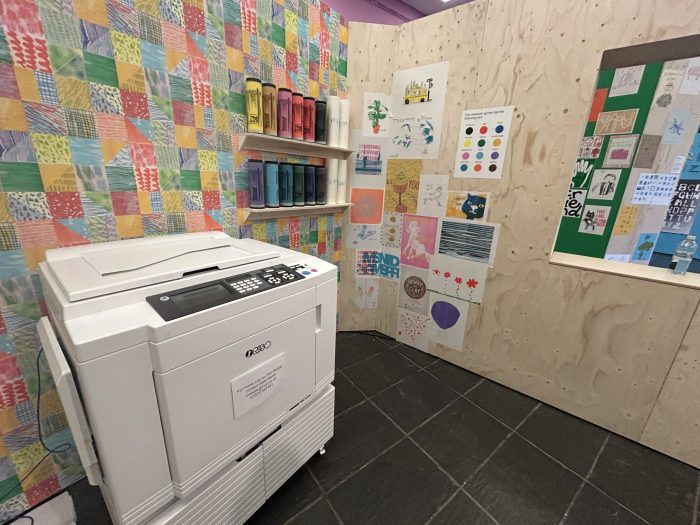
When most people hear the word printer, they probably don’t immediately think of an art gallery.
But step into the creative world of Risograph printing and that changes very quickly.
During a recent visit to BALTIC Centre for Contemporary Art, we had the opportunity to see how RISO technology is being used within a very different print environment — one filled with artists, publications, collaborative projects, workshops, experimental prints and bold installations.
And it was a powerful reminder that a RISO isn’t simply a machine for reproducing an image. In the right hands, the printing process becomes part of the creative process itself.
Colour, layers and imperfection
One of the characteristics that makes Risograph printing so recognisable is its approach to colour.
Rather than reproducing an image in the same way as a conventional digital printer, colours can be printed in individual layers using ink drums. That opens up enormous creative possibilities.
Artists can experiment with combinations, overlays, registration and paper stocks to create results that feel tactile and individual. And those tiny variations that might traditionally have been regarded as imperfections? In Risograph printing, they’re often part of the appeal.
From zines to installations
Throughout the visit, we saw the process used in remarkably different ways.
There were artist publications and zines, posters, illustrations and prints — but also collaborative artwork and work extending across entire walls.
Foundation Press’s Imaginary Vessels (For Sally) offered a particularly striking example, using modular Risograph-printed wallpaper to transform print into an installation.
It demonstrated something easy to forget when we talk about printing technology: the page doesn’t have to be the final destination.
Creativity people can participate in
Another aspect that stood out was participation.
The space wasn’t simply filled with work to observe. There were opportunities to draw, create and contribute, alongside collections of work produced by different people.
It reflected something that has always been central to Risograph culture: accessibility and experimentation. You don’t necessarily need to know exactly what the finished result will look like before you begin. Sometimes the process of making it is the interesting part.
The technology behind the creativity
Of course, behind all that experimentation sits a very clever piece of print technology.
Risograph printing uses a master-based process and ink drum, enabling colour layers to be printed separately. It’s a technology with a very distinctive creative identity — but one that ultimately exists to enable the person standing in front of the machine.
Because the most interesting thing we saw wasn’t the printer itself. It was what people had decided to do with it.
Our visit was a brilliant reminder of just how broad the world of RISO print really is.
From high-volume everyday printing to artist books, zines, workshops and gallery installations, the applications may look completely different — but the principle remains the same.
Putting powerful print technology into people’s hands and seeing where their ideas take it.
Interested in exploring what Risograph can bring to your creative practice or print environment? Discover more about RISO and the possibilities of Risograph printing.