


HOW YOU CAN PUT SUSTAINABLE PRINTING ON YOUR ORGANISATION’S AGENDA
Sustainability is no longer a future ambition. It’s a business priority. Yet while organisations are investing heavily to reduce their environmental impact, one everyday activity is often overlooked: printing.
The way a business prints can have a real impact on its carbon footprint, its waste output, and ultimately, its ability to meet the environmental goals it’s set out to achieve.
This blog takes a closer look at how making the right choices with your printing equipment can help you reduce the environmental impact of printing across your organisation and throughout the wider environment.
The environmental cost of traditional printing
Conventional laser printing relies on high energy consumption, toner cartridges, and heat-based processes that generate ozone emissions and waste. And despite the recyclable nature of paper, poor paper sourcing and wasted printing runs can lead to resource depletion and deforestation, making printing more of an environmental liability rather than an asset.
But it doesn’t have to be this way. Choosing the right technology and materials can turn printing into a genuine contributor to ESG performance across any sector, from schools and universities to offices and charities.
A smarter, cleaner way to print
One of the most effective ways to reduce the environmental impact of printing is to adopt technology designed with sustainability in mind. Modern inkjet systems can significantly reduce energy consumption, eliminate ozone emissions, and minimise waste compared with traditional laser devices.
RISO’s Colour Inkjet Printers are built around this principle. Requiring no toner and occupying a relatively small footprint, they help organisations cut their environmental impact without compromising on performance.
By using oil-based pigment ink that’s fast-drying and water-resistant, we help you cut down on waste and make the entire process cleaner than traditional toner-based printing.
At the heart of this is our ForceJet™ technology, which uses a cold printing process rather than heat.
This innovative approach to printing brings a range of environmental benefits:
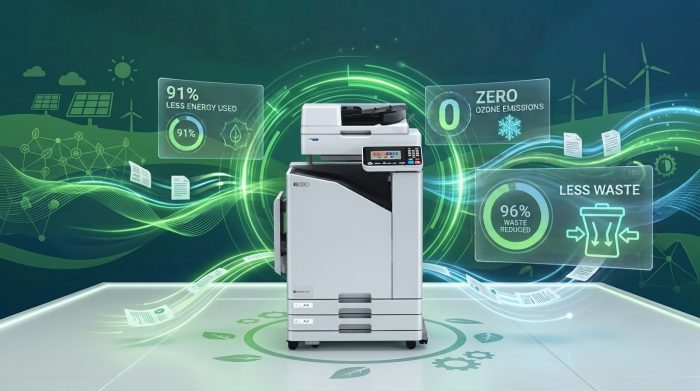
- 91% less energy used: Our cold printing process significantly cuts electricity consumption and carbon footprint compared with heat-based laser printing.
- Zero ozone emissions: No heat in the print-imaging stage means none of the ozone output associated with traditional toner devices.
- 96% less waste: Fewer moving parts means less to replace, giving you long-lasting durability with minimal maintenance.
But the positive impacts don’t end there. Because RISO Colour Inkjet Printers are built for high-speed, high-volume output, you can produce the materials you need quickly and reliably, without the bottlenecks often associated with laser devices.
And with ink that is generally less expensive than toner, plus fewer maintenance demands, you can also help reduce day-to-day operating costs as well as waste from substandard printouts, reprints, and inefficient workflows.
This means your environmental sustainability gains don’t have to come at the expense of productivity or budgets.
What our customers say
The Harmony Trust is a multi-academy trust comprising 15 schools in Oldham, Derby, Rochdale and Tameside. Alongside the trust’s core aims to raise attainment in schools and ensure that every child is provided with the right support to succeed, there is a strong focus on sustainability:
“At Harmony Trust, we’re committed to fostering a better planet for future generations. The eco-credentials of the RISO printers compared with toner devices — including zero ozone emissions, reduced energy use, and little wastage — play a vital role in helping us meet our eco-goals”
David Taylor, Head of ICT, The Harmony Trust
Going beyond the page
At RISO, our commitment to sustainability doesn’t stop at the hardware. Whenever you choose RISO, you contribute to our Plant A Tree initiative in partnership with Ecologi, which sees a tree planted for every machine purchased, working towards our target of 100,000 trees planted.
These reforestation projects support communities in Kenya, Madagascar, and Mozambique, creating jobs and restoring ecosystems. One such project, run with the International Tree Foundation in Kenya’s Rift Valley, is entirely community-led, with local people raising the seedlings and benefiting directly from the income it generates.
Make your own positive impact
From lower energy use and reduced waste to high-speed output, cost efficiency, and meaningful reforestation projects, sustainable printing is about more than what happens on the page. By choosing technology that supports both operational needs and environmental goals, your organisation can make a practical change that delivers lasting benefits.
If you want to make the sustainable choice contact RISO to find out more and book a demo.